
Table of Contents
The Most Expensive Thing in Your Team Is Unspoken.
Every team has one. The thing everyone in the room already knows, and nobody has said out loud.
Maybe it's the strategy nobody believes in anymore. The colleague who checked out mentally two years ago. The burnout everyone treats as a private problem. The direction nobody dares to question, because questioning it feels like a career risk.
I call it the gray elephant.
It isn't hiding. It's just unspoken.
It won't arrive as a surprise. It will explode as one.
Futures thinking has a whole zoo for the things we fail to see coming. Here's the short version.
Black swan. The rare event nobody could have predicted (Taleb).
Gray rhino. The obvious threat charging straight at us while we look away (Wucker).
Black elephant. A cross between the two, popularised by Thomas Friedman. Visible to everyone, ignored by everyone, treated as a shock when it finally blows up.
Gray elephant. The Baby Elephant growing inside your own group, on its way to become Black Elephant. Everybody sees the shadow. Nobody names it. The opportunity to catch and tame it before it grows too big and wild.
When a black elephant ruptures, it feels like a black swan. A key person resigns. A client walks. A team collapses into sick leave. A project that "was going fine" suddenly isn't.
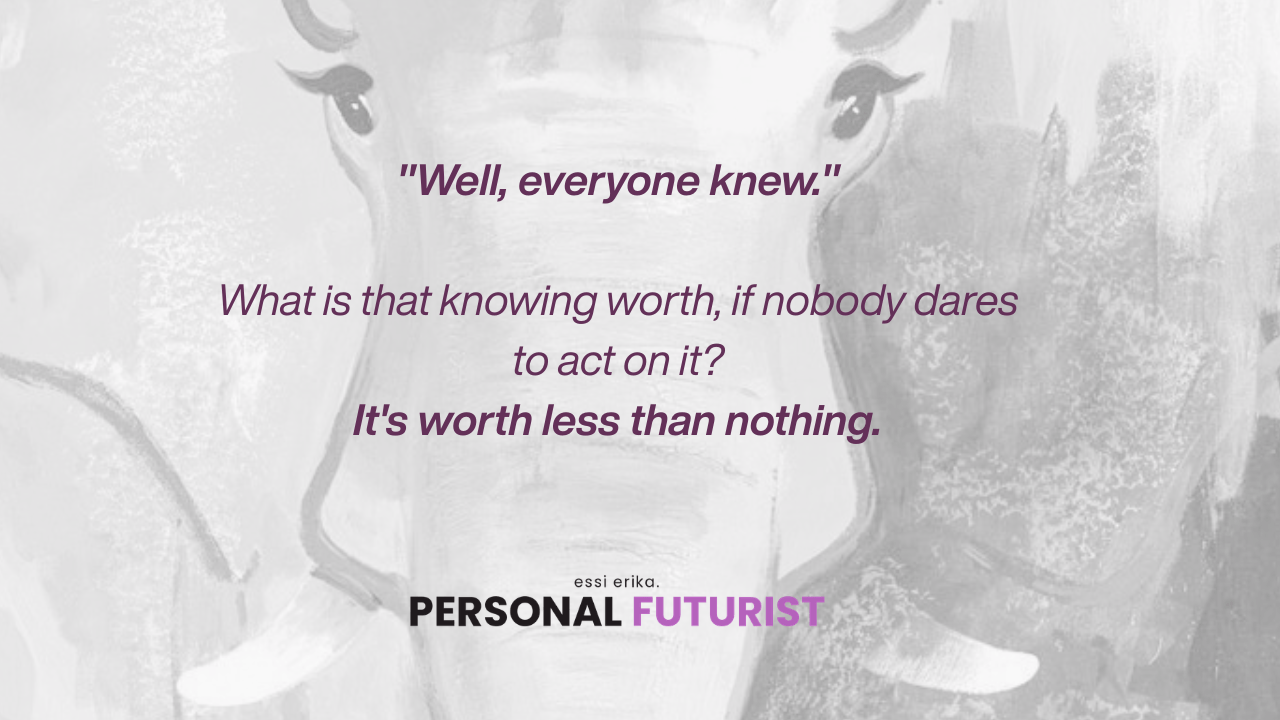
Then, a week later, the corridor verdict: "Well, everyone knew."
Max Bazerman and Michael Watkins call these predictable surprises: disasters whose ingredients were visible long before they arrived. So what is knowing worth, if nobody dares to act on it?
Less than nothing. Knowledge nobody is allowed to use gives you the illusion of awareness, without any of the options that come with it.
Why smart groups stay silent
Staying quiet isn't stupidity. It's usually the rational choice, given what speaking up costs.
Fear and threat. People learn that raising problems is pointless or dangerous. Silence then becomes the collective norm (Morrison & Milliken). Under threat, groups also get more rigid, not more creative (Staw et al.).
Defence and ego. Chris Argyris called these topics undiscussables. The next step is that their undiscussability becomes undiscussable too. Saving face, your own or the boss's, wins over saying what's true.
Structures. Hierarchies, incentives and unwritten rules decide whose voice is safe. Most of us carry quiet beliefs like "don't embarrass your manager in public" (Detert & Edmondson).
Resource scarcity. When time and money are tight, attention narrows to what's urgent. What's important but uncomfortable gets pushed further down the list (Mullainathan & Shafir).
Emotional capacity. The biggest one. Naming an elephant takes energy, and many teams have none left. People protect the resources they still have (Hobfoll). Research on Nokia's smartphone decline found that fear shared across management levels shaped what was reported upward and what got attention (Vuori & Huy).
In the end, the silence is about feelings, not information.
The rupture doesn't negotiate
An elephant that stays unnamed doesn't stay the same size. Small deviations get normalised, one reasonable step at a time, until one day they aren't small anymore (Vaughan).
And when the rupture comes, it wipes everything away at once: the trust, the options, and the time you would have had to shape a response.
The futures you could have chosen turn into the future that happened to you.
That's the real cost. You don't only lose the problem. You lose the ability to steer.
Naming it before it names you
A Futures Dialogue is not your typical keynote. It's a conversation starter for Brave Futures spaces.
I speak with people, not to them. Nobody argues a case. Nobody has to find the one right way forward. The conversation grows from the people in the room, and we build on each perspective together.
It changes the maths of speaking up. When the space is designed for honesty, the interpersonal risk drops (Edmondson), and what everyone privately knew becomes something the group can actually use.
We don't fix it yet, and nobody leaves with a forced action plan. First comes the naming, together.
What becomes possible
- The undiscussable becomes discussable, and stays that way after the conversation ends.
- Energy comes back. Tiptoeing is exhausting, and it stops.
- You read the weak signal while you still have options. That's the difference between shaping a change and being hit by one.
- The group gets a shared language and a direction, not a to-do list.
- The futures you can imagine together get wider again. Collaboration for shared outcomes starts with honesty.
Sometimes naming it is the whole relief.
So, what's the gray elephant in your room?
You don't have to name it in the comments. But you might want to name it somewhere.
Explore Futures DialoguesReferences: Argyris, C. (1990). Overcoming Organizational Defenses. Allyn & Bacon. · Bazerman, M. H., & Watkins, M. D. (2004). Predictable Surprises. Harvard Business School Press. · Detert, J. R., & Edmondson, A. C. (2011). Implicit voice theories. Academy of Management Journal, 54(3), 461–488. · Edmondson, A. (1999). Psychological safety and learning behavior in work teams. Administrative Science Quarterly, 44(2), 350–383. · Friedman, T. L. (2014). Stampeding black elephants. The New York Times. · Hobfoll, S. E. (1989). Conservation of resources. American Psychologist, 44(3), 513–524. · Kish-Gephart, J. J., Detert, J. R., Treviño, L. K., & Edmondson, A. C. (2009). Silenced by fear. Research in Organizational Behavior, 29, 163–193. · Morrison, E. W., & Milliken, F. J. (2000). Organizational silence. Academy of Management Review, 25(4), 706–725. · Mullainathan, S., & Shafir, E. (2013). Scarcity. Times Books. · Staw, B. M., Sandelands, L. E., & Dutton, J. E. (1981). Threat-rigidity effects in organizational behavior. Administrative Science Quarterly, 26(4), 501–524. · Taleb, N. N. (2007). The Black Swan. Random House. · Vaughan, D. (1996). The Challenger Launch Decision. University of Chicago Press. · Vuori, T. O., & Huy, Q. N. (2016). Distributed attention and shared emotions in the innovation process: How Nokia lost the smartphone battle. Administrative Science Quarterly, 61(1), 9–51. · Wucker, M. (2016). The Gray Rhino. St. Martin's Press.
Tulevaisuusdialogi: Harmaa elefantti
€990,00
Tulevaisuusdialogi · Harmaa elefantti Ilmassa leijuu asia, jonka kaikki jo tietävät. Kukaan ei vain ole sanonut sitä ääneen. 90 minuuttia. Fasilitoitu ryhmäkeskustelu. Yksi harmaa elefantti, joka nostetaan nurkasta pöydälle, yhdessä. "Tämä ei ole tavallinen keynote. Tämä on keskustelun avaus rohkeisiin… read more

Tulevaisuusvalmentajan tapaaminen: Harmaa elefantti
€90,00
Tulevaisuusvalmentajan tapaaminen · Harmaa elefantti Nimeä signaalisi Jokin häiritsevä asia on pyörinyt mielessäsi jo pitkään. Aistit sen. Et ole vielä sanonut sitä ääneen. Täällä voit sanoa, kahden kesken ja luottamuksellisesti. "Yksi ihminen, yksi signaali, yksi rehellinen keskustelu. Täällä ei aseteta… read more

FAQs
What is a Personal Futurist?
A Personal Futurist is a futures coach who applies strategic foresight to one person's life. The aim is not to predict what will happen but to expand your understanding of what is possible for you, and to help you move toward the futures that fit who you are.
The work combines three dimensions: Fuel (your energy, wellbeing and resilience), Futures (futures literacy, systemic understanding and transformative thinking) and Focus (your direction, values and identity).
What is personal futures coaching?
Personal futures coaching is a structured, iterative process that uses tools from futures research, the same ones organisations use in strategy and innovation, for individual purposes. You explore the changes inside and around you, build futures images, test your assumptions and notice weak signals of what could come next.
It is not a one-off course. It is a way of approaching change that you keep using long after the coaching ends.
How is personal futures coaching different from life coaching, career coaching or therapy?
Life and career coaching often improve performance or reach a set goal within your current structures. Therapy often focuses on processing the past and treating psychological distress. Personal futures work is forward-facing: it first steps outside your current structures, looks at the wider range of possible futures, and only then asks which direction is truly yours.
These approaches complement each other. Personal futures work does not replace therapy when therapy is what you need.
Who benefits most from personal futures work?
Personal futures work often resonates with people who feel they have failed or lost their direction, feel successful but bored or misaligned, face a career or identity transition, sense burnout in their current way of living and working, or experience uncertainty as disorientation rather than opportunity. It suits anyone who wants to move from reactive adaptation to intentional navigation.
I don't know what to do with my life. Can a Personal Futurist help?
Yes. Not knowing is a common and honest starting point. Instead of pushing you to pick an answer quickly, a Personal Futurist helps you widen the view first: what is changing around you, what energises you and which futures feel like yours. Clarity then grows from exploration rather than pressure. A Guided Futures Exploration or a Personal Futurist Consultation is a good first step.