
Table of Contents
Identity Crisis? Personal Futurist meets Human Design.
Apparently I'm a Projector. My behavior disagrees.
I'll be honest with you: I did not go looking for Human Design. It found me the way most uncomfortable things do — through someone else's enthusiasm at exactly the wrong moment.
I was in the middle of a busy stretch. Lots of ideas, lots of output, a certain kind of restlessness that I've learned to recognize as my operating mode. Someone sent me a link. "Just put in your birth data, you'll love it." I humored them.
The result? I'm a Projector.
Which would be fine, except that everything I know about Projectors, their invitation-based strategy, their need for rest, their role as guides rather than generators of energy, felt like a description of someone else. Someone calmer. Someone who sits back and waits.
That is not me. Or at least, it's not who I thought I was.
So what even is Human Design?
Human Design is a system developed in the late 1980s by Ra Uru Hu (born Alan Robert Krakower). It pulls from four traditions: the I Ching, the Kabbalah's Tree of Life, the Hindu-Brahmin chakra system, and Western astrology. The result is a body graph. A kind of energetic blueprint — calculated from your exact birth date, time, and place.
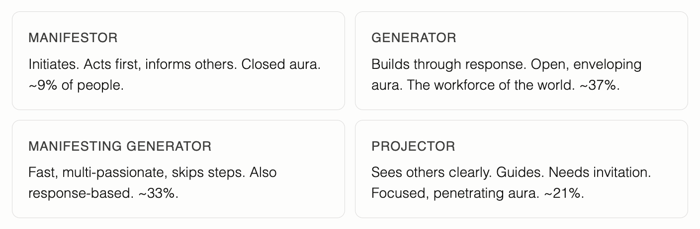
The system maps defined and undefined energy centers, channels, and gates.
Where a Generator has a defined Sacral center: a reliable, renewable engine, a Projector's Sacral is typically open. They absorb and amplify the energy around them, but don't generate it themselves.
"Wait for the invitation," the Human Design community says to Projectors. Which is advice I have never once followed in my life.
Here's the uncomfortable part.
I recognized the Manifesting Generator in myself immediately. The quick pivots. The simultaneous projects. The tendency to jump ahead of linear process, frustrate people who prefer step-by-step, and still somehow arrive somewhere useful. I thought: yes, that's me.
And yet: the body graph doesn't lie about birth data. I'm a Projector. With a lot of defined channels that create what feels like momentum. Which might explain why, from the outside, and often from the inside, I run like a Manifesting Generator. Until I don't. Until I crash.
If you know, you know.
The critique is fair. So is the curiosity.
Human Design is not science. Let's not pretend otherwise. To my knowledge, there's no peer-reviewed body of evidence, no double-blind studies confirming that your birth time determines your energetic strategy. The system is elaborate and internally consistent, which makes it compelling, but internal consistency isn't the same as truth.
I hold that skepticism seriously. As a futures researcher, I'm professionally committed to evidence, rigor, and not mistaking a good story for a proven one.
But here's the thing about futures work, and about research in general: The most inspiring territory isn't what we already understand. It's what we don't yet. The edge cases. The phenomena that don't fit the existing model. The things that millions of people experience but that no methodology has caught up to yet.
No researcher worth their curiosity should be blind to what we haven't yet explained.Dismissing something because it lacks a proof framework is its own kind of closed thinking, and closed thinking has never built a useful future.
Human Design may be unverified. It may also be pointing at something real about human energy, attention, and relational dynamics that our current instruments simply aren't measuring yet. I don't know. And this "I don't know" is not a my weakness or lack of self-confidence. It's the most honest place a researcher can stand.
What I do know is this: the useful question isn't "is it true?" It's "what does it reveal?" Equally, "what does my resistance to it reveal?"
Because here's what I noticed: my immediate reaction to being called a Projector was rejection. And that's interesting. The parts of ourselves we're quickest to refuse are often the ones worth sitting with longest.
What a personal futurist does with this
My work is about helping people think forward. Building the self-awareness and clarity needed to make better decisions about what comes next. And identity is always in the middle of that work, whether we name it or not.
When someone sits down with me, we're not just talking about goals or plans. We're talking about who they believe themselves to be, and whether that belief serves them.
That gap between self-concept and lived experience? It's one of the most generative places I know of.
Human Design gave me a very personal experience of that gap. The system said: you may be burning borrowed energy. My ego said: but I love burning energy.
Both things can be true. That's actually the point.
The future isn't built by people who have themselves perfectly figured out. It's built by people who stay curious about the figuring-out.
So: Projector or Manifesting Generator?
Probably a Projector who has spent twenty years in environments that reward Generator and Manifesting Generator behavior, and got very good at performing it. That's not failure. That's adaptation. But adaptation has costs, and knowing what they are, that's where the work gets interesting.
I'm not converting to Human Design nor any other single system. I'm not building my calendar around my strategy or waiting for invitations before I initiate. But I am paying attention to the patterns the system pointed at. The crashes after big output. The sensitivity to recognition, or the lack of it. The way I do my best work in advisory, observatory, catalytic roles rather than as the main engine.
Maybe I was the main engine growing up, and now its time to convert the remaining energy toward catalytic roles. Most probably the decision to become Personal Futurist was an unconscious decision towards this development
Ultimately, its not about astrology, human design or any other framework. Its about having yet another system to apply, see what are the learnings it may provide for my journey of becoming my future self / finding my true self / evolving and dancing with the change. Developing my Mindset Beyond Futures.
Its about daring to look honestly at myself through lenses presented for me. The system gave me access to a new language. What I do with it is up to me.
As your identity and futures are up to you. What you do with and how you choose to interpret the systems of your life - it is up to you.